
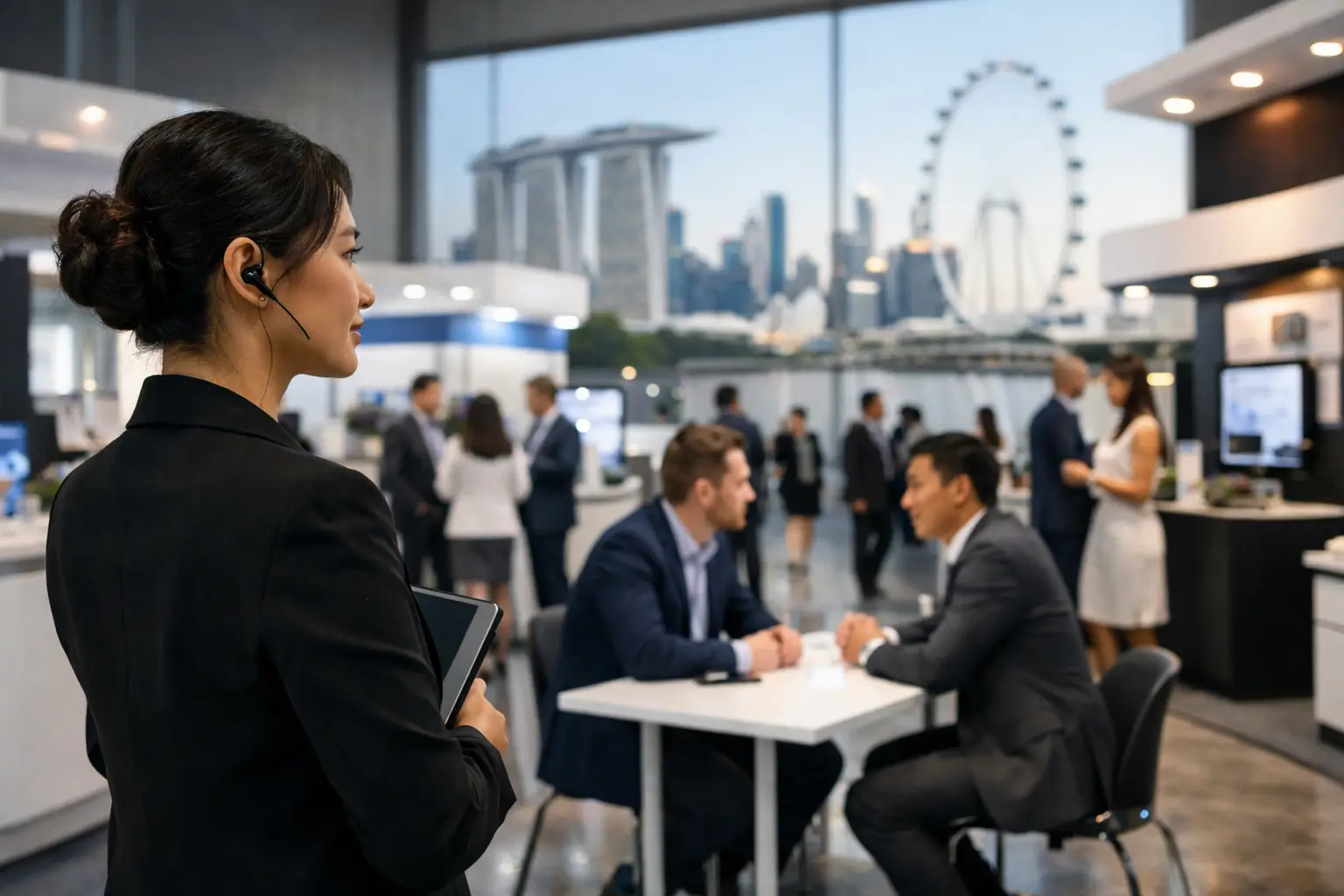
A strong exhibition is not won by the booth design alone. It is won in the moments visitors rarely notice: how easily they find the space, whether the demo starts on cue, how the queue moves, whether the lighting supports the product, and how confidently your team can focus on conversations instead of logistics. That is the standard exhibition event management Singapore brands need when reputation, lead generation, and customer experience are all on display.
For marketing teams, brand managers, and business leaders, an exhibition is a live expression of the company. It needs to look distinctive, but it also needs to work under real show conditions: fixed move-in windows, shared loading bays, venue regulations, technical constraints, supplier dependencies, and busy public traffic. The best results come from treating creative direction and operational planning as one connected process.
What Exhibition Event Management in Singapore Really Covers
Exhibition management is often mistaken for booth fabrication or venue booking. Those are important parts of the project, but they are only the visible layer. A professionally managed exhibition brings together the event strategy, visitor journey, production plan, vendor coordination, on-ground crew, technical setup, and post-event handover.
The starting point should be a clear commercial and communications goal. Is the exhibition meant to launch a product, secure sales leads, strengthen distributor relationships, recruit talent, educate customers, or build brand visibility? A product demonstration zone requires a different layout, staffing plan, and AV approach than a thought-leadership showcase or a trade event hospitality lounge.
That objective informs every later decision, from the floor plan and messaging hierarchy to the number of meeting areas and the pace of the showflow. Without it, teams can spend heavily on visual features that attract attention but do little to help visitors understand, remember, or act on the brand message.
The visitor journey is the real design brief
A booth should give visitors an immediate answer to three questions: what is this brand offering, why should I care, and where do I go next? The answer may come through a bold visual statement, a live demo, a product display, an interactive screen, or a well-trained host. It should not rely on visitors reading a wall of copy while standing in a crowded aisle.
Guest flow matters just as much. Open sightlines can bring people in, but too much openness may leave sales conversations exposed. A private meeting area supports higher-value discussions, yet it can consume valuable footprint and make a compact booth feel closed off. The right balance depends on expected traffic, the sales cycle, the nature of the product, and the event audience.
Start With the Venue Rules, Not the Renderings
Singapore offers a wide range of exhibition environments, from major convention venues and trade halls to malls, atriums, hotels, and public-facing roadshow locations. Each has its own loading procedures, fire safety requirements, ceiling restrictions, electrical rules, rigging approvals, access hours, insurance requirements, and contractor policies.
These details should shape the concept early. A dramatic suspended feature may be impractical if rigging is restricted. A high-output lighting design may need adjustment when power allocation is limited. A large product display may require special delivery planning, lifting equipment, or a revised route through the venue. Resolving these realities before creative approvals protects both the timeline and the budget.
Venue sourcing also goes beyond capacity. Consider the arrival experience, public transport access, food and beverage options, parking, nearby hotels for regional guests, available breakout areas, and the quality of existing technical infrastructure. For a business-to-business exhibition, a venue that supports efficient meetings may be more valuable than one with the highest footfall. For a consumer activation, visibility and dwell time may be the deciding factors.
Build a production schedule that respects show deadlines
Exhibition timelines are unforgiving. Move-in and move-out slots are usually fixed, and a delayed delivery can affect every crew working after it. A practical production schedule maps the full journey: design approval, fabrication, print artwork, technical checks, vendor briefings, delivery windows, installation, testing, exhibitor handover, show days, dismantling, and asset return.
The schedule should also identify what cannot move. These are commonly venue submission dates, electrical orders, rigging approvals, artwork deadlines, freight arrivals, and final staffing confirmations. Once those milestones are visible, the project team can make decisions with fewer surprises.
A useful rule is to reserve time for testing rather than assuming setup equals readiness. Screens need content checks. Microphones need sound checks. Internet-dependent lead capture systems need a backup plan. Demo equipment needs to be tested in its final position, under actual event lighting and power conditions. The final hour before opening should be for polish and contingency, not basic installation.
Design for Attention, Then Plan for Conversion
An exhibition booth needs a reason for visitors to stop, but a crowd is not the same as a successful outcome. The experience should move naturally from attraction to engagement and then to a clear next step.
For some brands, this means a scheduled presentation that gives visitors a reason to return at set times. For others, it means an approachable product specialist, a short guided demonstration, or a consultation area where prospects can discuss requirements away from the aisle. Interactive elements can be highly effective, but only when they support the message. A game that draws a queue without qualifying the audience may create noise without producing meaningful leads.
Lead capture deserves the same level of planning as staging or visual branding. Decide what information the sales team needs, who will input it, how consent will be handled, and what follow-up happens after the event. If staff are expected to scan badges, record notes, give a demo, manage a queue, and answer technical questions at once, the process will break down during peak periods.
A better approach is to assign clear roles. Hosts can welcome and direct visitors. Product experts can lead deeper conversations. A dedicated lead-capture team can ensure data is complete. A floor manager can watch guest flow, replenish collateral, solve minor issues, and keep the team aligned with the showflow.
AV Production Is Part of Brand Credibility
At an exhibition, AV is not a background service. Sound, lighting, video, power distribution, and screen placement affect how credible, clear, and comfortable the brand feels. A premium product can lose impact when a presentation screen has glare, a demo audio track is drowned out by neighboring booths, or cables disrupt the guest path.
The technical plan needs to respond to the environment. In a loud trade hall, directional sound or headphones may work better than open speakers. In a brightly lit atrium, LED displays may be more effective than projection. In a compact space, lighting can define zones and make products stand out without adding physical walls.
There is also a cost trade-off. Larger screens, custom lighting, immersive content, and elaborate staging can elevate attention, but not every event needs a major technical build. The question is whether each production choice helps visitors understand the product, stay engaged, or take the next action. A focused setup with excellent content and reliable operation often outperforms a complex installation with too many competing features.
The Show-Day Plan Is Where Confidence Comes From
A polished exhibition feels calm because the planning behind it is detailed. Before doors open, the team should have a clear show-day run sheet covering crew call times, opening checks, replenishment, presentation schedules, staff breaks, VIP arrivals, media requests, cleaning, troubleshooting, and escalation contacts.
On-ground coordination is particularly valuable when several partners are involved. Fabricators, printers, AV crews, venue teams, promoters, artists, caterers, freight providers, and client stakeholders each have different priorities. One production lead who can coordinate decisions, track dependencies, and respond quickly prevents the client team from becoming the default problem solver.
Contingency planning should be practical rather than dramatic. Have spare print materials, backup playback files, charging options, basic repair tools, additional extension cables, and clear contacts for urgent venue support. If a product demo is central to the experience, prepare a non-live version or alternate presentation in case connectivity, equipment, or timing changes.
Choose an Exhibition Partner That Can Think and Deliver
The right event partner should be able to challenge a vague brief constructively, translate ideas into a workable build, and take ownership of execution from the first site visit to final dismantling. Creative concepts matter, but they need to be grounded in venue rules, budget realities, construction timelines, crowd behavior, and show-day staffing.
Ask how the team manages vendor coordination, technical rehearsals, venue submissions, safety requirements, guest flow, and live issue resolution. Review whether their proposal explains not only what the exhibition will look like, but how it will operate. The strongest plans give stakeholders a clear picture of the visitor experience and the behind-the-scenes control required to deliver it.
For organizations planning a high-stakes exhibition in Singapore or across Southeast Asia, Teamup Event brings creative storytelling and production discipline into one managed process. From concept development and venue coordination to staging, AV production, crew management, and on-ground control, the goal is simple: an exhibition that feels confident to your guests and manageable to your team.
Your booth may occupy a limited footprint, but the impression it creates can travel much further. Start with the experience you want visitors to remember, then give that idea the detailed planning, technical care, and show-day leadership it deserves.