
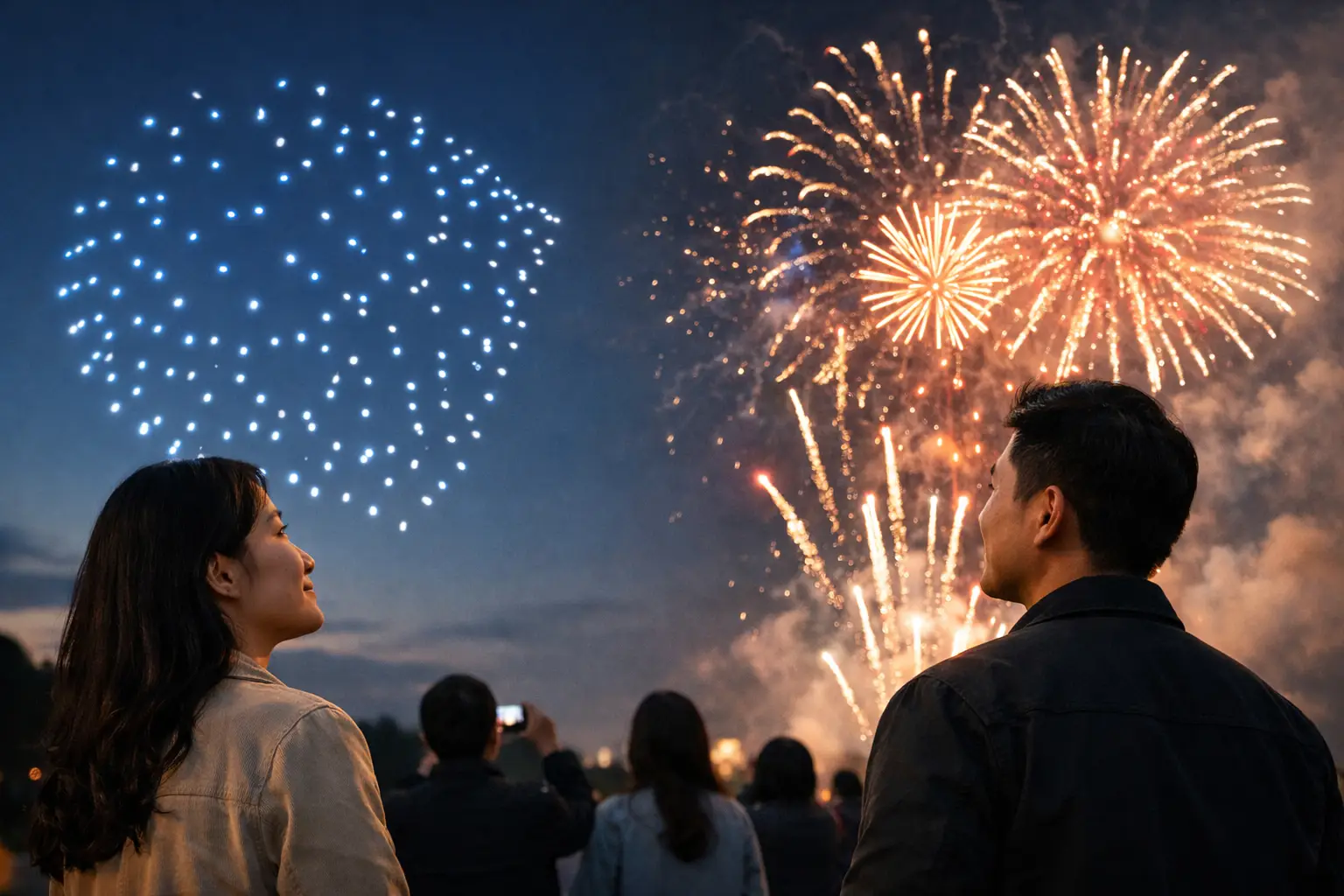
A closing spectacle can change the final impression of a product launch, gala dinner, or public brand event. When guests look up together, cameras come out, conversations pause, and the brand gets a moment of full attention. The decision between a drone show versus fireworks display is not simply about choosing a more impressive finale. It is about selecting the format that fits your venue, audience, brand story, operating conditions, and event objectives.
For corporate planners, the strongest choice is usually the one that can be delivered with confidence from the first creative brief to the final send-off. Both formats can create a memorable high point. They simply do it in very different ways.
What This Decision Is Really About
Fireworks deliver immediate scale, sound, color, and emotional release. They suit moments that call for celebration on a grand, unmistakable level: a national occasion, a festival, a waterfront gathering, or a company milestone where the goal is pure excitement. The experience is familiar, visceral, and impossible to ignore.
Drone light shows use coordinated fleets of illuminated drones to create moving images, patterns, words, and logos in the night sky. They are particularly effective when a brand needs the spectacle to carry a specific message. A product can appear to rise above the venue. A company’s anniversary number can transform into its logo. A story can unfold frame by frame in a way that guests recognize and record.
The question is not whether drones are “better” than fireworks. It is whether your event needs an emotional burst, a branded visual narrative, or a carefully designed combination of both.
Drone Show Versus Fireworks Display: The Core Difference
Brand storytelling and visual control
A drone show gives brands far more control over the image guests see. The fleet can form custom graphics, animated sequences, names, taglines, and symbolic visual moments. For a product launch, corporate anniversary, destination event, or sponsor-led activation, that flexibility can turn the sky into part of the campaign.
That control also makes drone shows highly shareable. A well-designed sequence is not just beautiful from the ground. It creates distinct camera-ready moments for guests, media teams, and social content creators. The most effective concepts are not overloaded with messages. They use a few clear visual chapters that can be understood within seconds.
Fireworks are less literal but often more universally emotional. They communicate triumph, celebration, and occasion without needing explanation. A choreographed fireworks display can be timed to music and built around color palettes, but it cannot draw a logo or spell out a message with the same precision. If your brief is “make this feel like a major celebration,” fireworks may be the more natural creative choice. If the brief is “make our brand the story,” drones often have the advantage.
Sound, energy, and guest emotion
The sound of fireworks is part of their power. The first launch creates anticipation, the bursts create applause, and the finale can give a room or outdoor crowd a genuine sense of release. For a high-energy dinner and dance, concert, or public countdown, that physical impact can be exactly right.
Drones create a different mood. Their visual movement feels cinematic, refined, and intentional. Because they are comparatively quiet from the audience’s perspective, they work well when speeches, live music, dining, or nearby programming must continue without being overwhelmed. They can also suit premium events where the desired effect is wonder rather than noise.
Audience composition matters here. Families with young children, guests sensitive to loud sound, nearby residents, and venues with animal welfare considerations may make a quieter aerial format more appropriate. Conversely, a large crowd gathered for a celebratory outdoor moment may respond strongly to the drama of fireworks.
Venue, Safety, Permits, and Weather
A spectacular concept still has to work on the ground. The venue assessment is where an experienced production team protects the idea from becoming an operational risk.
Fireworks require a suitable launch area, controlled safety distances, fire-risk planning, crowd management, and approvals from the relevant authorities and venue stakeholders. Wind direction, fallout zones, nearby buildings, sensitive facilities, and local restrictions can all affect the design. In dense urban settings, those requirements may narrow the list of viable sites significantly.
Drone shows require their own planning discipline. Airspace considerations, flight permissions, geofencing, operating areas, launch and recovery zones, pilot control, battery management, and contingency procedures must be addressed well before show day. The drones need a clear, protected operating environment, not just an attractive skyline.
Weather is a real consideration for either format. Strong winds, rain, electrical activity, haze, and poor visibility may change what can be safely presented. A responsible show plan includes a weather-monitoring process, decision points, and a clear guest communication plan if the performance needs to be delayed, shortened, or canceled. Promising a sky-based finale without discussing contingencies is not creative confidence. It is poor event planning.
Budget Means More Than the Performance Fee
When comparing a drone show and fireworks display, the headline quote is only one part of the budget. The total production scope may include permits, site surveys, security, crew, transport, technical rehearsals, audio synchronization, lighting, staging adjustments, safety personnel, insurance, and crowd-control measures.
Drone shows can be a strong investment when the visual content has a central role in the event campaign. The ability to incorporate logos and bespoke animation may reduce the need for other large-format branding elements, while extending the show’s value through photography and video. The production work is front-loaded: creative design, flight programming, simulation, and operational approvals need sufficient lead time.
Fireworks costs can vary widely based on duration, scale, firing positions, effects, choreography, and site requirements. A shorter display may create an excellent finale for a private event, while a more ambitious sequence can require significant technical and safety infrastructure. The best comparison is not a simple price-per-minute calculation. It is the cost of delivering the desired guest impact safely and reliably.
For either option, ask for a proposal that distinguishes the creative concept from the full execution plan. Clear scope prevents surprises later, especially when multiple vendors, a venue operator, and public-facing safety requirements are involved.
When a Drone Show Is the Better Fit
A drone show is often the stronger choice when the event needs a custom brand story in the sky. It works particularly well for launches, milestone celebrations, destination experiences, sponsor activations, and executive events where polished visual detail matters.
It can also be the practical choice where noise limitations are a concern or where the event experience needs to feel modern and premium. A fleet can create a countdown, reveal a new identity, celebrate an employee achievement, or end a conference with a visual statement that connects directly to the event theme.
The format does require adequate lead time and a venue that supports the operating plan. It is not a last-minute decorative add-on. The strongest drone shows are integrated into the showflow from the beginning, with music cues, guest positioning, host messaging, lighting transitions, and content capture planned around the performance.
When Fireworks Are the Better Fit
Fireworks are often the right answer when the objective is large-scale celebration and immediate emotional impact. They are well suited to festive corporate occasions, countdowns, outdoor concerts, public events, and ceremonies where guests expect a bold communal finale.
They can also be more appropriate when custom messaging is not essential. If the event already has strong stage content, live entertainment, and brand presence, fireworks can provide a clean closing release without asking the aerial display to carry every communication objective.
The key is to respect the site conditions. A waterfront, open field, or properly managed outdoor venue may support an exceptional display. A tightly built-up location with limited safety clearance may not. The venue does not just host the event. It determines what can be responsibly produced.
Consider a Choreographed Hybrid Moment
For select large-scale events, drones and fireworks can complement one another. Drones can establish the story, shape the logo reveal, or count down to a major announcement. Fireworks can then provide the emotional crescendo. The result can be highly effective when every transition is coordinated through one showflow and one command structure.
A hybrid approach is not automatically more impressive. It involves more approvals, more technical coordination, and more complex safety planning. It should be chosen because the creative idea genuinely benefits from both formats, not because more effects always mean more impact.
Build the Finale Into the Full Guest Experience
The final performance should not feel disconnected from the rest of the event. Guest arrival times, dinner service, speech timing, stage cues, AV playback, lighting states, access routes, viewing angles, and post-show departure all influence whether the moment lands properly.
For example, a drone show may require guests to be moved to a designated viewing area before the first formation appears. Fireworks may require certain outdoor areas to be cleared and guest flow redirected. In both cases, a rehearsal of the operational sequence matters as much as the spectacle itself.
Teamup Event plans aerial finales as part of a complete production, aligning creative direction with venue logistics, AV production, safety requirements, and on-ground coordination. That approach gives planners one accountable partner while keeping the guest experience composed, clear, and beautifully run.
Choose the format that gives your audience a reason to look up, feel something together, and remember why they were there. When the creative idea and production plan are equally strong, the final sky moment becomes more than a finale. It becomes the image guests take home with them.