
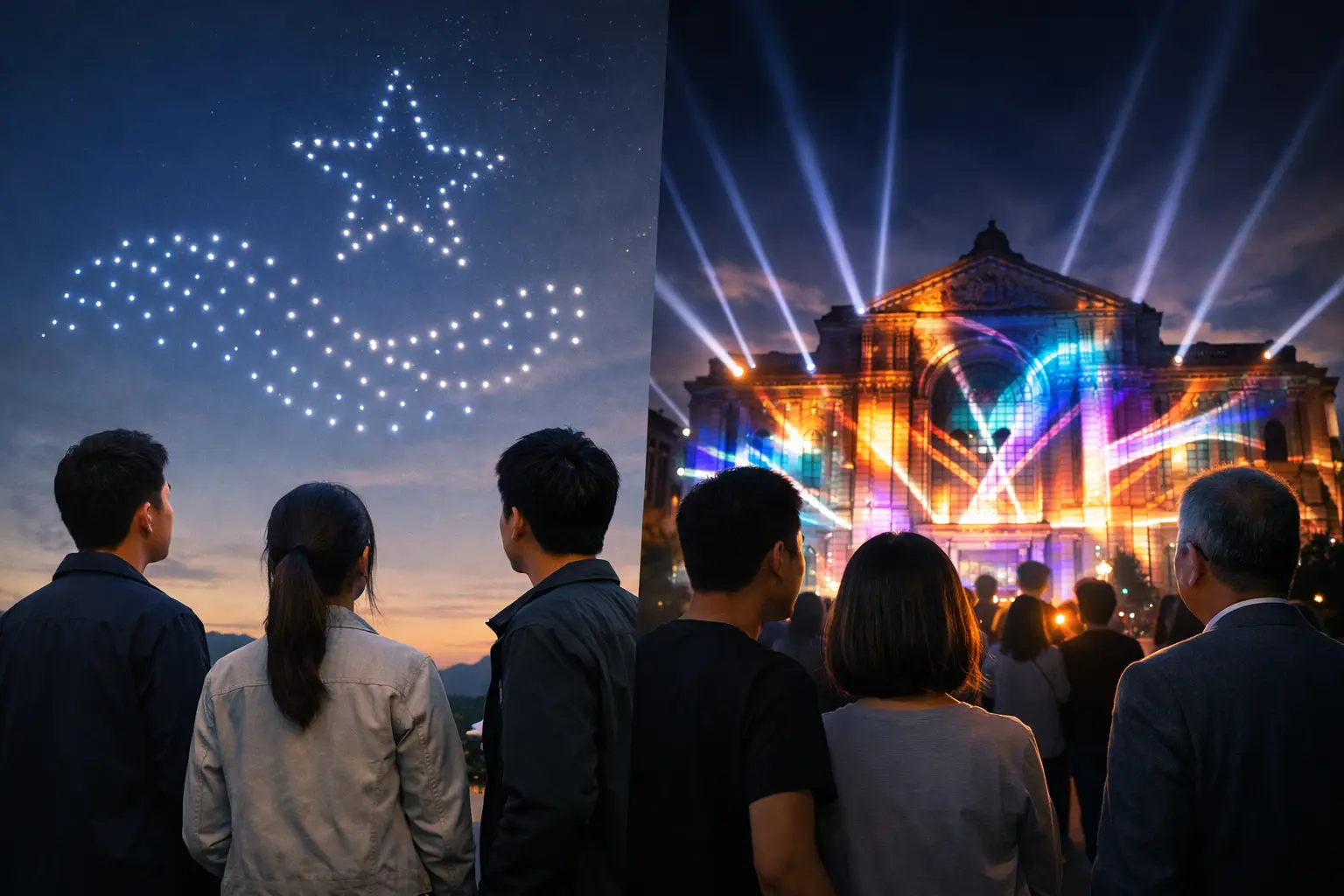
A closing moment can define how guests remember an entire event. For a product launch, gala dinner, or public celebration, the choice between drone formations versus projection mapping is not simply about selecting the most impressive visual. It is about matching a creative idea to the venue, audience, timing, brand story, and practical conditions that will determine whether the moment lands perfectly.
Both technologies can turn a logo, message, or visual narrative into a high-impact experience. Yet they work in very different ways. Drone formations create images in the open sky, while projection mapping transforms a physical surface into a moving canvas. The right option depends on what guests need to see, where they will be standing, and what the show needs to achieve.
Drone Formations Versus Projection Mapping: The Core Difference
A synchronized drone show uses a programmed fleet of illuminated drones to form shapes, animations, text, and brand symbols against the night sky. The result is visible from a wide viewing area and often feels monumental because the image appears above the audience rather than in front of them. It is particularly effective for outdoor brand launches, waterfront celebrations, festivals, national occasions, and large corporate events with a strong finale requirement.
Projection mapping uses high-output projectors, media servers, and carefully designed content to cast visuals onto a building facade, stage set, sculpture, screen, product structure, or other defined surface. It can make architecture appear to move, reveal a product through animated visuals, or take guests through a detailed story that unfolds frame by frame. Projection mapping is often the stronger choice when the venue itself should become part of the creative concept.
The difference is also emotional. Drone formations create a shared sense of scale and spectacle. Projection mapping creates immersion and detail, drawing the audience into a controlled visual environment.
When Drone Formations Create the Stronger Moment
Drone formations are built for visibility. A fleet can form a company logo above a ballroom lawn, create a countdown over a waterfront event, or animate a story that is visible to hundreds or thousands of guests at once. For brands seeking a signature social-media moment, the sky provides a dramatic canvas that is difficult to ignore.
They work especially well when the event has an outdoor viewing zone with a clear line of sight. A guest at a dinner reception can step outside for a choreographed finale, while attendees at a public event can watch from a designated audience area. Because drones operate above the crowd, they can give a large-scale event a single visual focal point without requiring every guest to be close to a stage.
For corporate audiences, a drone show can be more than a logo reveal. It can visualize a company’s milestones, markets, product features, values, or future direction. The best sequences use a simple narrative structure: build anticipation, introduce recognizable imagery, deliver the brand reveal, and end with a memorable final formation. Trying to place too much text or too many complex messages in the sky can reduce clarity, especially for guests watching from a distance.
There are practical considerations. Drone shows need suitable weather, controlled airspace, site approvals, an appropriate launch area, and a safe audience layout. Wind, rain, nearby flight activity, and local aviation regulations can affect feasibility. This does not make drone formations unreliable, but it does mean planning needs to begin early and contingency thinking must be part of the production process.
When Projection Mapping Is the Better Creative Tool
Projection mapping excels when storytelling needs precision. It can show product details, animated graphics, film content, live-action footage, and branded typography with a level of visual richness that drones cannot replicate. If a vehicle, architectural facade, stage portal, or custom-built product display is central to the event, projection mapping can make that object feel alive.
This makes it particularly valuable for product launches, conferences, exhibition openings, gala entrances, and indoor celebrations. It can be integrated into a keynote reveal, a CEO walk-on, or a theatrical opening sequence where music, lighting, sound effects, and live performers need to work to an exact showflow.
Unlike a drone show, projection mapping can be used indoors. A controlled ballroom or theater environment allows the production team to manage ambient light, viewing angles, audio, and timing more closely. That control is valuable for clients with fixed schedules, daytime events, or venues where outdoor flight operations are not practical.
However, projection mapping depends heavily on the surface. The ideal projection area has sufficient scale, a clear audience view, limited competing light, and dimensions that can support the content design. A glass facade, heavily textured wall, bright room, or venue with obstructions may require additional treatment, a custom scenic structure, or a different visual solution. The creative concept should follow a site survey, not the other way around.
Comparing Visual Impact, Flexibility, and Guest Experience
For broad, open-air impact, drone formations usually have the advantage. Guests can look up together, and the scale naturally supports a climactic reveal. It is an excellent choice for an audience that includes VIPs, employees, customers, media, and the public, provided the venue and permits support it.
For detailed narrative and close-up visual control, projection mapping is often stronger. It is better suited to an audience seated toward a stage, a product that must be shown with precision, or an event where visual content needs to synchronize tightly with speeches, performers, and audiovisual cues.
Audience position matters more than many planners expect. A drone formation can be seen from a broad area, but guests should still face the intended viewing direction. Projection mapping needs even more disciplined sightline planning. Guests behind columns, at extreme side angles, or too far from the projection surface may not experience the full effect. Seating plans, stage orientation, guest flow, and pre-show announcements all influence the final result.
Timing matters too. Drone formations are generally most effective after dark, while projection mapping performs best in low-light conditions. At an event with a packed program, the production schedule should account for guest movement, dinner service, speeches, cueing, and the transition into the reveal. A spectacular visual loses momentum if guests are still queuing for drinks or returning from the restroom when the show begins.
Budget Is About More Than the Technology
Neither option has a universal price point. The budget depends on the creative ambition, duration, venue conditions, technical requirements, content complexity, approvals, crew, rehearsals, and event-day logistics.
A drone show may involve fleet size, flight planning, aviation permissions, safety management, launch-site logistics, insurance, and weather contingency planning. The number of drones affects the complexity and resolution of the images, but a larger fleet is not automatically the better show. A clear, well-choreographed concept can be more memorable than a crowded sequence of formations.
Projection mapping budgets are shaped by projector brightness and quantity, throw distance, content production, media servers, rigging, scenic preparation, power distribution, and ambient-light control. Mapping a landmark building can require substantial technical planning, while a purpose-built indoor stage surface can offer more predictable costs and execution.
The useful question is not which technology is cheaper. It is which investment best supports the business objective. If the event needs public visibility and a large-scale closing statement, drones may justify the production requirements. If the priority is product storytelling, sponsor integration, or a controlled theatrical reveal, projection mapping may deliver more value.
Can You Combine Both?
Yes, when the event format and budget support a layered experience. Projection mapping can open the story indoors or on a stage, introducing the campaign narrative before guests move to an outdoor viewing area for a drone finale. The two formats can also share visual language, music, and key brand messages so the experience feels intentionally connected.
This approach requires disciplined show planning. The transition between spaces must be managed with clear guest instructions, sufficient time, accessible routes, weather preparation, security coordination, and audio coverage. It is not enough to schedule two impressive effects. They need to feel like one event story.
Start With the Event Conditions, Not the Trend
The best creative choice begins with practical questions: Is the event indoors or outdoors? What will guests see from their actual positions? Is the key message emotional, detailed, or both? What approvals, weather exposure, venue rules, and production windows apply? Answers to these questions shape an experience that feels effortless to guests because the complex work has been handled behind the scenes.
For high-stakes events, the strongest visual is the one that fits the site, supports the showflow, and gives the audience a clear reason to look up, look forward, and remember the moment. Teamup Event can help turn that decision into a production plan with the creative direction, technical coordination, and on-ground control needed from the first brief to the final send-off.