
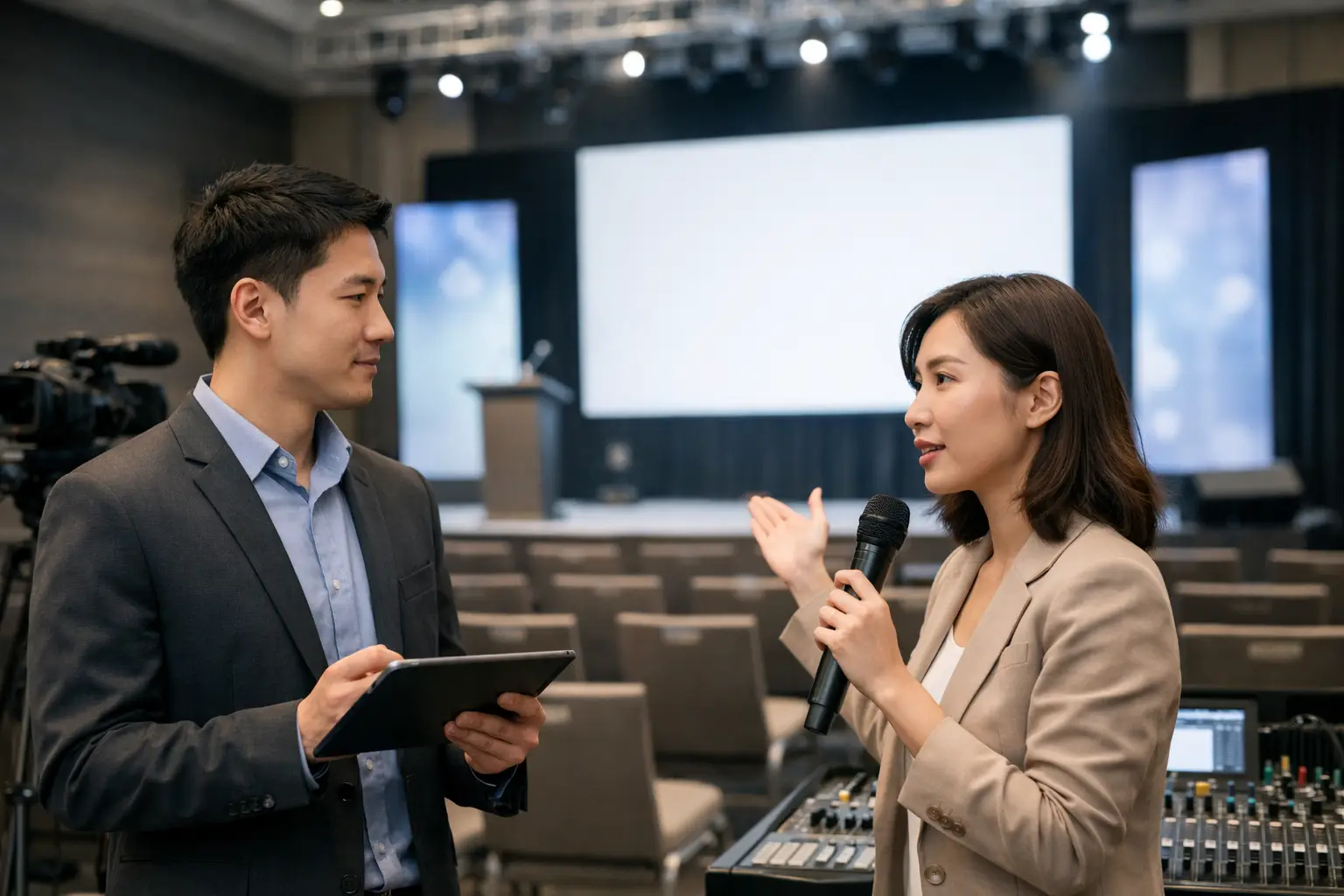
A missed cue at a leadership conference is rarely just a technical issue. It can leave a CEO waiting in silence, make a product video feel underwhelming, or cause a carefully planned awards segment to lose momentum. A proper conference AV company review should therefore look beyond screens, speakers, and quoted equipment. It should reveal whether a production partner can protect the pace, message, and credibility of your event when the room is full and there is no second take.
For corporate teams, AV is not a standalone vendor line item. It is the working system behind the stage, presentations, audience attention, hybrid participation, and show-day confidence. The right company brings creative judgment and disciplined control to every cue. The wrong fit may offer attractive rates but leave your internal team managing technical decisions they should never have to make.
Start With the Event, Not the Equipment List
Before comparing AV companies, be clear about what the conference must achieve. A quarterly town hall, regional sales kickoff, investor briefing, and multi-day industry forum can all require very different production approaches. The technical setup should be shaped by the audience size, venue conditions, program format, content volume, and the level of brand impact required.
A company that immediately sends a generic package of LED walls, microphones, and lights without asking about your showflow may be solving the wrong problem. Good AV planning starts with questions: How many presenters will be on stage? Are presentations changing throughout the day? Will there be panel discussions, remote speakers, live polling, walk-in videos, or award segments? Is the audience in one ballroom, multiple breakout rooms, or also joining online?
The answers affect more than the gear. They determine screen sightlines, microphone allocation, confidence monitor placement, playback redundancy, camera coverage, technical crew count, rehearsal time, and the way each session transitions into the next.
How to Conduct a Conference AV Company Review
A useful review balances visible production quality with the less visible systems that keep an event on track. A polished showreel can demonstrate visual capability, but it cannot tell you how a team handles a last-minute slide change or a presenter who arrives with an unfamiliar laptop five minutes before going on stage.
Look for relevant conference experience
Ask for examples that resemble your event in scale and complexity. A supplier with strong concert credentials may be excellent at live sound and lighting, but corporate conferences require additional discipline around speaker support, presentation management, executive comfort, content accuracy, and timing.
Relevant experience includes managing multi-speaker agendas, executive walk-ons, keynote playback, panel microphones, room resets, and concurrent breakout sessions. If your event includes a regional audience, it also helps to understand how the company has managed multilingual content, different presentation formats, and stakeholders joining from several markets.
You do not need identical past events. You do need evidence that the team understands the pressure points of a business-critical program.
Assess the technical proposal for clarity
A strong proposal explains why each element is included. It should identify the display solution, audio system, lighting approach, staging requirements, playback workflow, communications system, and crew roles in terms your stakeholders can understand.
Be careful with proposals that are either overly vague or unnecessarily equipment-heavy. “Full AV package” is not enough for a conference with senior executives and multiple content sources. At the other extreme, a long list of technical specifications can obscure whether the setup actually fits the room and program.
Ask how the supplier has accounted for room dimensions, ceiling height, ambient light, viewing distance, speaker movement, and audience layout. A large LED wall may create impact in one ballroom but be excessive for a smaller leadership session. Projection can be effective in a controlled environment, while LED may be the better choice when daylight or strong stage lighting is unavoidable. The right answer depends on the venue and the experience you want guests to have.
Test their showflow thinking
The most capable AV partners do not simply operate equipment. They translate the agenda into an executable showflow, with clear cues, responsibilities, and fallback plans.
Ask how they manage transitions between walk-in music, opening videos, keynote presentations, panel discussions, Q&A, and closing segments. Find out who calls the show, who controls presentation playback, and how stage managers communicate with the technical team. For a complex conference, these roles should be clearly assigned rather than handled informally.
The showflow should also account for practical realities. Presenters run late. A video may need to be shortened. An executive may decide to take questions from the floor. A dependable team plans for these moments without making the audience aware that anything has changed.
Examine crew planning, not just equipment
AV quality depends heavily on the people behind the console. One technician cannot reasonably manage audio, graphics, video playback, lighting, and stage changes for a high-stakes conference. The crew structure should match the program complexity and venue footprint.
For example, a conference may require a project manager during planning, an AV producer or show caller, audio engineer, video or graphics operator, lighting operator, stage manager, presentation technician, camera operators, and crew supporting breakout rooms. Not every event needs every role, but the supplier should explain where responsibilities sit and how coverage is maintained during breaks, rehearsals, and live sessions.
Also ask whether the people proposed will be the people on site. Some providers sell with senior specialists, then assign unfamiliar freelancers at the last minute. Freelance crew can be highly skilled, but they need a clear briefing, defined workflow, and accountable production leadership.
Questions That Reveal Operational Reliability
Client testimonials matter, especially when they mention calm problem-solving, punctual setup, and responsive communication. Still, direct questions often reveal more than a five-star rating.
Ask how the company handles redundancy for critical presentation playback, microphones, and internet-dependent elements. Clarify the process for collecting slides, checking video formats, testing remote speaker connections, and managing speaker laptops. If your event is hybrid, ask how they will monitor audio for both the room and remote audience, since a setup that sounds acceptable in the ballroom may be difficult for online participants to follow.
You should also understand their rehearsal process. A technical rehearsal is not simply a sound check. It is the time to confirm presenter entrances, slide advance methods, video cues, confidence monitor content, microphone handovers, and the pace of the show. For executive-led events, even a short rehearsal can prevent avoidable stress.
Finally, ask who has decision-making authority on site. When venue access changes, a cable route is restricted, or the agenda shifts, your team should know exactly who will coordinate the response.
Pricing: Compare Scope Before You Compare Totals
A lower quote is not always lower cost. It may exclude setup hours, rehearsals, content management, transport, rigging, power distribution, overtime, or sufficient crew coverage. These items can surface later as change orders or create compromises that affect the event experience.
Request a scope that separates equipment, labor, planning, logistics, and any assumptions. This makes it easier to compare proposals fairly and gives procurement teams a clearer view of where differences come from.
There are sensible ways to manage budget without weakening the event. You may reduce decorative lighting, simplify stage scenic elements, use fewer camera positions, or consolidate breakout-room requirements. Cutting backup systems, rehearsal time, or essential technical roles is usually a higher-risk decision. The savings may look efficient on paper, but the exposure sits squarely on show day.
Choose a Partner That Reduces Coordination Burden
For many internal teams, the best AV company is not the one with the biggest inventory. It is the one that makes the entire production easier to manage. That means coordinating with the venue, advising on stage layout, identifying technical constraints early, supporting presenters, and keeping all moving parts aligned with the event objective.
At Teamup Event, AV production is planned alongside creative direction, guest flow, staging, logistics, and on-ground coordination. This integrated approach is particularly valuable when your conference includes multiple vendors, executive stakeholders, entertainment, or a tightly timed program.
A conference should feel composed from the audience’s perspective, even when dozens of cues are being managed behind the scenes. Choose the team that asks precise questions early, documents the plan clearly, and gives your people confidence to focus on their guests, speakers, and message when the lights come up.