
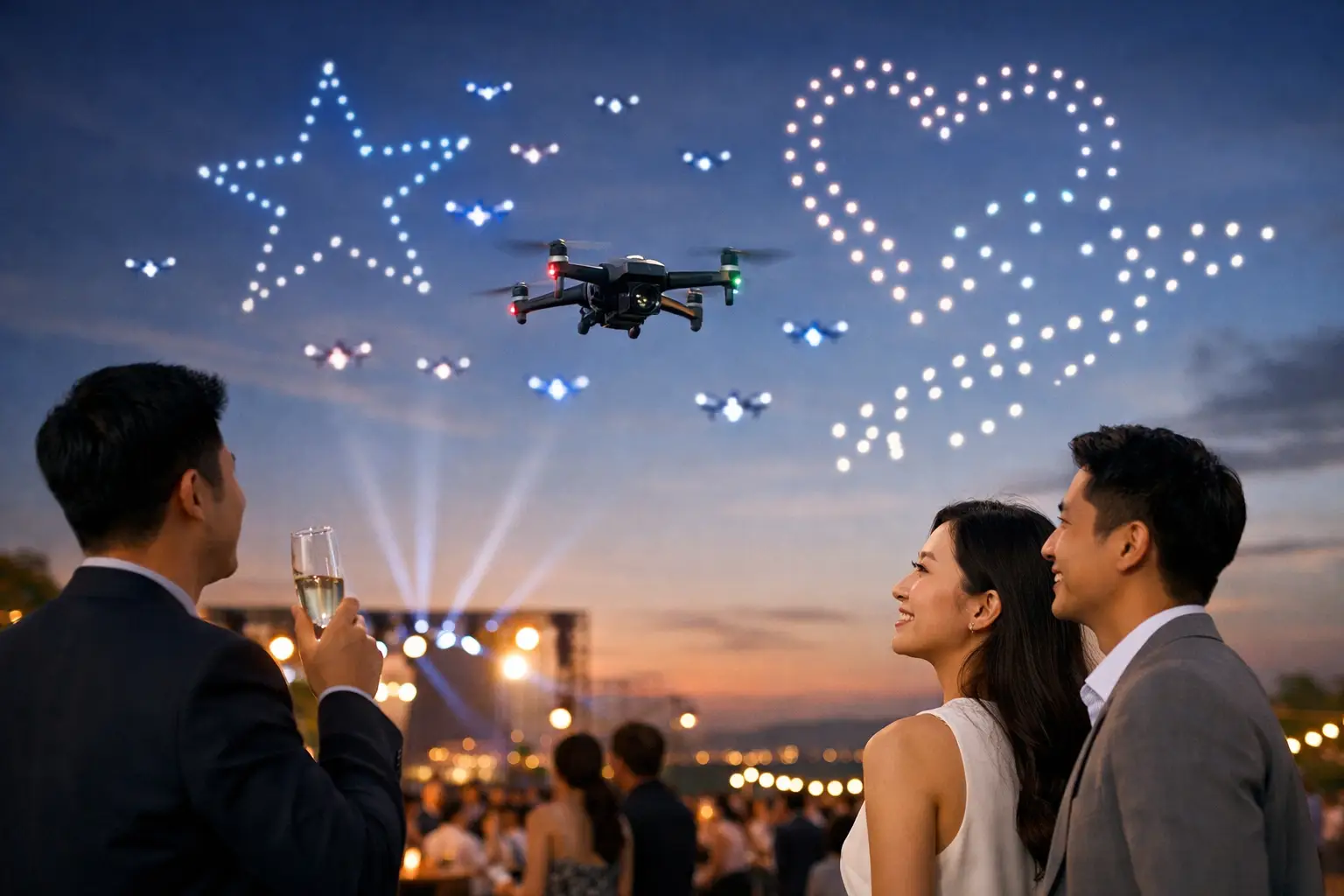
A ballroom can be transformed with lighting, sound, and a strong stage reveal. But when guests step outdoors and hundreds of lights rise into the night to form a company logo, a product, or a message of thanks, the energy changes immediately. Drone entertainment creates that rare kind of shared moment: one that gets people looking up, taking photos, and talking long after the final send-off.
For corporate events, brand launches, public celebrations, and large-scale dinners, a synchronized drone show can be far more than a visual finale. It can carry a brand story across the sky. The result is memorable, but the work behind it must be carefully planned. Airspace, venue conditions, guest viewing areas, timing, creative design, and on-ground safety all need to work together.
Why drone entertainment earns attention
Most event elements compete for attention. Guests are networking, checking messages, moving between stations, or arriving at different times. A drone show creates a natural focal point because it is visible, time-bound, and difficult to ignore. It brings the room, or the event grounds, into one shared experience.
That matters when the objective is emotional as well as practical. An annual dinner can use aerial formations to celebrate team achievements. A product launch can reveal a new identity in a format that feels designed for cameras. A milestone event can turn company history, values, and future ambitions into a short visual story rather than another speech on a screen.
The strongest shows are not built around the question, “How many drones can we fly?” They start with, “What should guests feel and remember?” A clean logo reveal may be right for a short awards-night finale. A public-facing brand activation may need a larger sequence with recognizable icons, campaign messaging, and a final callout that gives people a reason to capture and share the moment.
Start with the event story, not the sky
Drone entertainment works best when it belongs to the showflow. Treating it as an isolated add-on can make the experience feel disconnected, even if the formations are technically impressive. The better approach is to decide where it sits in the guest journey and what comes immediately before and after.
For example, a leadership address may lead into a countdown, a music cue, and an outdoor reveal that celebrates a new business chapter. At a product launch, an indoor audiovisual segment can introduce key product features before guests are directed to a viewing zone for an aerial version of the product silhouette. For a gala dinner, the show may be the closing reward after awards, performances, and a final toast.
This creative alignment affects practical decisions. The show duration, soundtrack, emcee script, lighting treatment, guest movement, and camera positions should be planned as one sequence. If guests need to move outdoors, the transition must be managed clearly. If the show begins too late, transport schedules, noise limits, or guest fatigue can reduce its impact.
A production partner should help translate a broad brief into a realistic storyboard. That includes deciding which visual messages are legible at distance, how long each formation should hold, and whether the audience will best understand a logo, a line of text, or a simple animated symbol. In aerial design, clarity is often more powerful than trying to say too much.
The production realities behind a polished drone show
A drone show is a precision production, not simply a performance with equipment. Before a creative concept is confirmed, the team needs to assess whether the location and operating conditions support it. That early feasibility work protects both the event experience and the project timeline.
Venue and viewing conditions
An open outdoor site is only the starting point. The event team must consider the available launch area, the audience viewing direction, nearby buildings, trees, reflective surfaces, ambient lighting, and access for crew and equipment. The ideal viewing area gives guests a clear sightline without placing them near operational zones.
In dense urban settings, a visually dramatic skyline may also introduce restrictions or logistical considerations. A waterfront venue may offer excellent sightlines but require additional planning for weather exposure and guest comfort. A resort or private estate may have more space but still need a clear plan for access, power, transport, and crowd control.
The show should be designed for the actual audience position, not a generic aerial rendering. A formation that looks perfect in a concept animation can lose its effect if guests are dispersed, facing the wrong direction, or blocked by venue structures.
Permits, safety, and operational control
Drone operations require the right approvals, safety processes, and experienced operators. These are not back-office details to address a week before the event. They shape the feasibility, timing, and site plan from the outset.
A responsible production approach includes clear operating zones, controlled launch and landing areas, appropriate barriers, crew access, audience management, and coordination with the venue and relevant authorities. It also means setting realistic expectations about what can be flown, where, and under which conditions.
Weather is one of the most important variables. High winds, rain, and poor visibility can affect operations, so contingency planning is essential. Depending on the event format, the backup plan may include a revised timing window, an alternative outdoor moment, or an indoor AV finale that still delivers the core brand message. There is no value in promising a sky show without discussing what happens if the sky does not cooperate.
Music, lighting, and timing
The drones are only one layer of the experience. Music gives formations pace and emotion. Lighting helps guide guests from the main event space to the viewing area. The emcee provides context without talking over the reveal. Security and ushers protect guest flow. Photography and video teams need their positions before the crowd arrives.
Timing is equally important. A show that starts while guests are still collecting drinks or moving through an exit route will not land as intended. The production schedule should account for dinner service, speeches, stage resets, transport plans, and venue curfews. Small timing decisions are often what separate a memorable finale from a technically successful one that half the audience misses.
Choosing the right use case for your event
Not every event needs a drone show. If the venue has limited outdoor access, the program is daytime-only, or the event’s purpose is intimate discussion, other creative formats may deliver better value. Drone entertainment is most effective when there is enough audience scale, a strong visual message, and a reason to create a collective peak moment.
It is especially well suited to company anniversaries, gala dinners, product launches, destination events, festivals, large employee celebrations, and public brand activations. The scale can vary, but the creative should match the occasion. A smaller corporate gathering may benefit from a concise, elegant sequence. A major public event may justify a richer story with multiple formations and coordinated media capture.
Budget should be discussed in relation to the full production picture, not only the number of drones. Site requirements, permits, creative programming, travel, crew, safety infrastructure, rehearsal time, music, and contingency arrangements all affect the final scope. A clear proposal helps decision-makers compare options based on outcomes and operational requirements rather than a headline figure alone.
How to brief a drone entertainment partner
The best briefs do not need to arrive with finished artwork. They need a clear business purpose. Share the event date, location, audience size, event format, desired message, brand assets, and the point in the program where you want the experience to happen. It is also useful to identify any non-negotiables, such as a product silhouette, anniversary number, campaign line, or VIP viewing requirement.
From there, the planning team can assess feasibility and recommend an appropriate concept. They should ask about venue restrictions, guest arrival and departure patterns, competing entertainment elements, media requirements, and who has final approval over brand visuals. This avoids last-minute revisions that can affect both production timing and creative quality.
For events in Singapore and across Southeast Asia, local coordination is particularly valuable. Venues, operating requirements, weather patterns, transport logistics, and approval timelines vary by market. A capable team brings creative direction and practical control together, coordinating the drone specialists alongside staging, sound, lighting, guest management, and the wider event program.
Make the finale feel earned
The most effective aerial shows do not rely on spectacle alone. They give guests a reason to care before the first drone lifts off. Build anticipation through the event narrative, make the viewing transition easy, and let the final formation say something specific about the people, brand, or milestone being celebrated.
When every production detail is considered from the first brief to the final send-off, drone entertainment becomes more than a photo opportunity. It becomes the moment your guests carry with them when the event is over.