
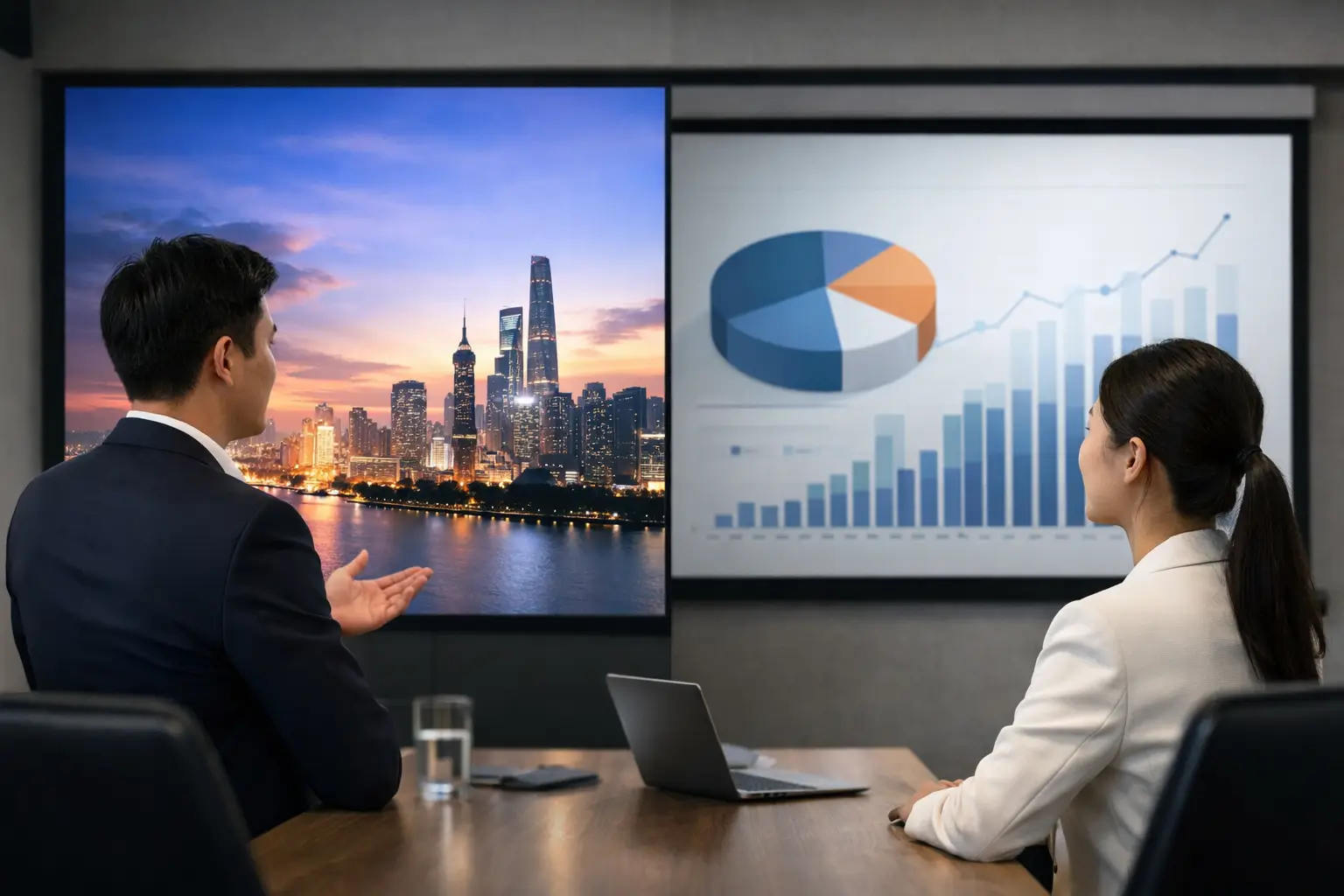
A CEO steps onto the stage for a keynote, the room lights remain up for note-taking, and every attendee can still read the data on screen. Or the same presentation begins in a ballroom with controlled lighting, where a large projected image creates a polished, cinematic backdrop without consuming the production budget. The LED wall versus projection screen decision shapes far more than how slides look. It affects staging, lighting design, camera coverage, guest sightlines, showflow, and the confidence of every speaker on stage.
For corporate conferences, product launches, annual dinners, concerts, and brand activations, neither option is automatically better. The right display is the one that supports the venue, audience size, content, and purpose of the event while keeping the full production practical to deliver.
LED Wall Versus Projection Screen: The Core Difference
An LED wall is made of modular display panels that produce their own light. It delivers a bright, high-contrast image and can be built in many sizes and configurations, including wide backdrops, curved canvases, columns, or split-screen layouts.
A projection screen reflects light from a projector. Its final image quality depends on projector brightness, screen material, throw distance, ambient light, and how well the room can be controlled. Projection remains a highly effective choice when the environment is suitable and the content does not demand extreme brightness or close-up detail.
The practical distinction is simple: LED walls give production teams more control in bright or visually complex environments, while projection can deliver a large, elegant image with less equipment and a lower investment in the right venue.
Brightness and Ambient Light
Brightness is often the deciding factor, particularly for daytime events, exhibition halls, glass-fronted venues, and spaces where house lights need to stay on. An LED wall remains visible under strong ambient light. This allows lighting designers to keep the room welcoming, highlight décor, and maintain clear pathways without washing out the presentation.
Projection works best in darkened or carefully managed rooms. A high-lumen projector can improve visibility, but it cannot fully overcome direct sunlight, bright ceiling fixtures, or uncontrolled spill from event lighting. If an executive presentation contains small charts, financial figures, or detailed product visuals, poor contrast can quickly become a guest-experience issue.
This does not mean projection is unsuitable for daytime programs. Blackout curtains, strategic screen placement, and deliberate lighting zones can produce excellent results. The question is whether the venue gives the production team enough control to create those conditions.
Image Quality Depends on Viewing Distance
LED walls are often praised for color, contrast, and visual impact, but pixel pitch matters. Pixel pitch is the distance between individual LED pixels. A tighter pixel pitch creates a sharper image for audiences seated close to the display, while a wider pitch can work well when guests are farther away.
For a ballroom dinner where the nearest tables are several yards from the stage, a larger-pitch LED wall may be appropriate. For a product launch with a front-row audience, a broadcast camera feed, or a detailed branded animation, the wall needs finer resolution. Selecting a wall based only on its physical size can result in visuals that look less refined at close range.
Projection can appear beautifully smooth, especially for video and presentation content viewed at a reasonable distance. However, image quality may soften if the projected image is stretched too large for the projector’s resolution. Screen size, projector resolution, and throw distance must be planned together rather than selected as separate items.
Venue Constraints Can Change the Answer
A display solution should be planned around the venue before the stage design is finalized. LED walls need a stable support system, adequate load-bearing assessment where relevant, sufficient power, data distribution, and safe access for installation. A large wall can also add depth and weight behind the stage, which matters in compact hotel ballrooms or venues with limited loading access.
Projection has its own technical requirements. Front projection needs a clear path between the projector and screen, which can be interrupted by presenters, set pieces, or audience movement. Rear projection avoids shadows but requires considerable space behind the screen. Ceiling-mounted projectors may be possible in some venues, but this depends on rigging points, ceiling height, and the venue’s policies.
For multi-day conferences, both options should also be assessed for operational access. Technicians need safe routes to service equipment, make adjustments, and manage cable runs without interfering with guest flow. The most impressive visual setup loses value if it creates a congested stage entrance or delays a quick program transition.
Consider What Will Be Shown on Screen
Content should lead the equipment choice. LED walls excel when a program relies on high-energy motion graphics, bold brand colors, video stings, live camera feeds, social content, and immersive visual moments. They are especially effective for launches, award segments, performances, and events where the screen is part of the scenic design.
Projection is often a strong fit for presentation-heavy conferences, training sessions, internal town halls, and formal dinners with a focused stage program. It can provide an expansive, clean canvas for keynote slides and video content without making the screen the dominant feature of the room.
For either format, content must be built to the correct canvas size and resolution. A standard 16:9 slide deck may need redesigning for an ultra-wide LED wall. Text should remain large enough for the farthest seats, and important information should stay clear of screen edges, speaker positions, confidence monitors, and camera framing. These details are best resolved during pre-production, not minutes before doors open.
Budget Means More Than Display Rental
An LED wall generally carries a higher rental and technical cost than a conventional projection setup, particularly when using fine-pitch panels, custom shapes, or large dimensions. Costs may also include processors, signal distribution, rigging or ground support, specialized technicians, transport, and extended setup time.
Projection can be more budget-efficient, but savings depend on the venue and required brightness. A large screen, powerful laser projector, rear-projection structure, blackout treatment, and additional labor can narrow the gap. If projection requires major room changes to overcome ambient light, an LED wall may become the more practical investment.
The useful comparison is not simply screen rental against screen rental. Compare the full production outcome: stage design, lighting freedom, setup hours, crew requirements, content adaptation, backup planning, and the impact on the audience experience. A lower initial quote is not always the lower-risk option for a high-stakes event.
When Each Option Usually Makes Sense
An LED wall is often the stronger choice when your event has four or more of these requirements:
- A bright venue, daylight exposure, or house lights that must remain on
- A high-impact product reveal, entertainment segment, or live camera program
- Detailed branded motion graphics and strong color reproduction
- A stage design where the display needs to act as a visual centerpiece
A projection screen is often the more suitable choice for a controlled ballroom or auditorium, a presentation-led program, moderate audience numbers, and a budget that is better directed toward speakers, entertainment, guest engagement, or other production elements.
Hybrid setups can also be effective. A central LED wall can carry key visual moments while projection screens provide IMAG, or image magnification, to guests seated farther from the stage. For larger conferences, this can balance visual impact with practical sightlines across the room.
Plan for Show-Day Reliability
The display choice should include a failure plan. LED walls benefit from spare panels, redundant signal paths where appropriate, and a technician monitoring the processor throughout the program. Projection setups need backup playback options, protected cable routes, lens and focus checks, and contingency plans for unexpected ambient light changes.
Rehearsal matters just as much. Speakers should test their content on the actual display, particularly if they are using presenter view, embedded videos, live demos, or remote contributors. The production team should check how the display reads from front tables, rear seats, camera positions, and any overflow areas.
At Teamup Event, display decisions are made alongside venue assessment, staging, lighting, content formatting, and showflow planning. That joined-up approach helps ensure the screen is not merely installed, but works as part of an event that feels controlled, memorable, and beautifully run.
The best display is the one guests barely have to think about. They simply see every message clearly, feel the energy of the room, and stay focused on the moment you have brought them there to experience.