
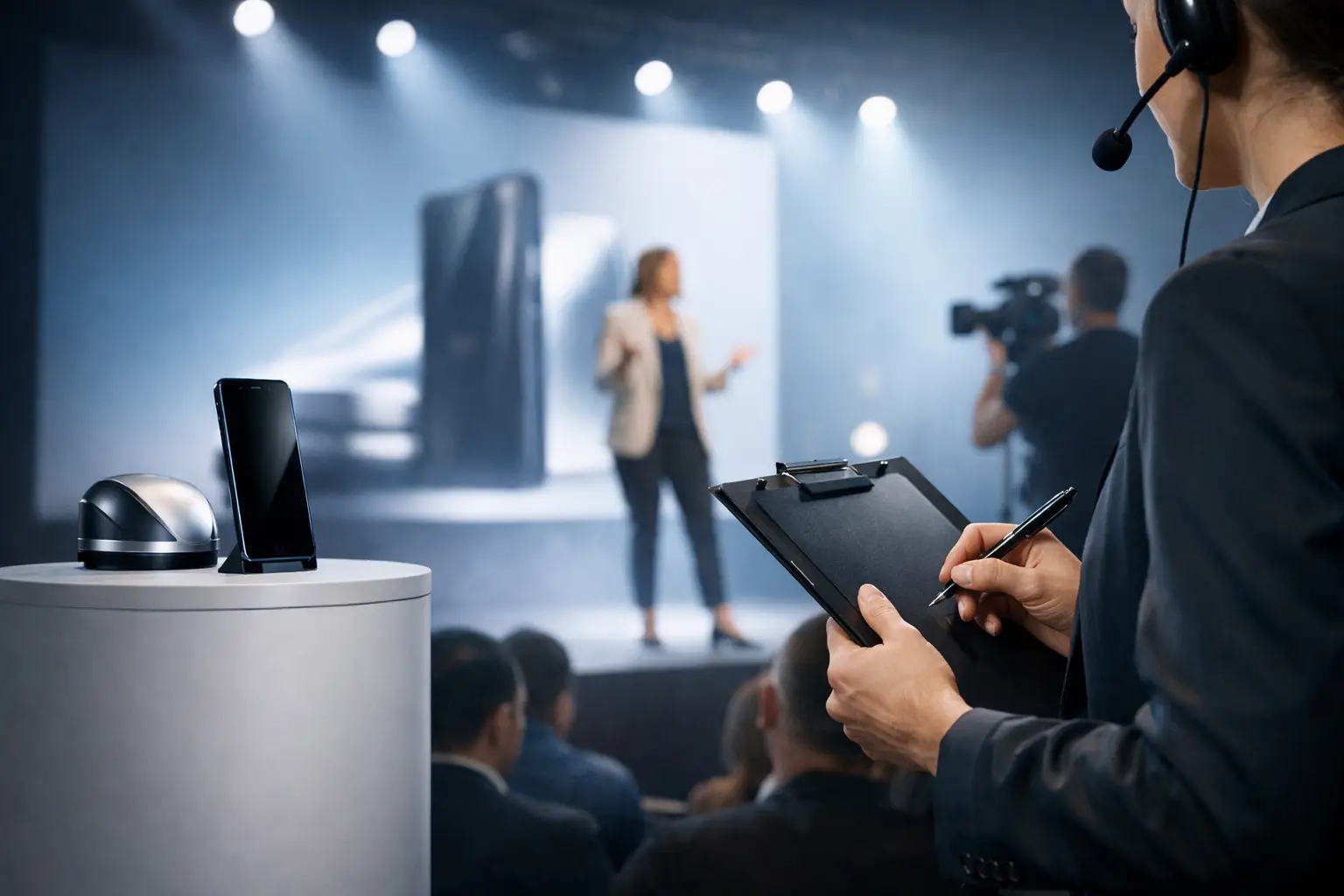
A product can be ready for market and still lose momentum in the room. A delayed reveal, an unclear demo, poor sightlines, or a registration queue at the wrong moment can distract guests from the innovation you worked hard to create. Product launch event management gives the occasion the structure, creative energy, and production control it needs to make a strong first impression.
For marketing leaders, brand teams, and executives, a launch is not simply an event date on the calendar. It is a high-visibility brand statement. Every touchpoint, from the invitation and arrival sequence to the stage reveal and post-event content, should help guests understand why the product matters and what to do next.
What Product Launch Event Management Really Covers
Effective launch management connects brand strategy with practical execution. It starts by defining the audience, business objective, product story, and desired response. Are guests expected to buy, book a meeting, request a demo, share content, or build confidence in a new direction for the company? The answer shapes the format.
A consumer-facing launch may need strong visual moments, hands-on trial zones, media access, creators, and a program built for social content. A B2B launch may place more value on live demonstrations, executive credibility, customer proof, technical briefings, and conversations with sales teams. Both can be memorable, but the event mechanics should serve different decisions.
From there, the work extends across venue sourcing, creative concepting, event flow, showflow, staging, AV production, lighting, sound, guest registration, vendors, talent, logistics, crew scheduling, and on-site coordination. The goal is not to add complexity for its own sake. It is to remove uncertainty before guests arrive.
Start With the Outcome, Not the Stage Design
A large LED wall can create impact. So can a drone light show, a dramatic lighting sequence, or a surprise performance. But visual production should amplify a clear message, not compensate for the absence of one.
Before confirming a venue or issuing a production brief, align stakeholders around a few decisions: who needs to be in the room, what they should remember, what proof will make the product credible, and what action should follow. This prevents the common problem of a launch that looks polished but leaves guests unsure about the offer.
The strongest product stories usually move in a simple sequence. First, establish the problem or opportunity. Then create relevance through a customer insight, market shift, or business challenge. Reveal the product at the point of highest anticipation, demonstrate how it works, and give the audience a clear next step.
That structure can be adapted for a 60-minute media launch, a full-day customer showcase, a regional dealer conference, or a roadshow. The scale changes. The discipline does not.
Build a Showflow That Protects the Reveal
A showflow is the working blueprint for the guest experience and production team. It goes beyond an agenda. It documents every cue: walk-in music, screen content, speaker entrances, lighting changes, videos, reveal mechanics, demos, question-and-answer sessions, and transitions.
Small gaps matter. If a product is unveiled before the screen content is ready, the impact is reduced. If a speaker needs to cross a dark stage while a camera operator changes position, the moment can feel awkward. If guests are invited to experience the product without a clear route or enough brand ambassadors, congestion quickly replaces excitement.
A detailed showflow gives every supplier and crew lead the same operational reference. It also identifies where backup plans are required. For example, a live product demonstration may need a pre-recorded fallback video, spare devices, duplicate cables, and a technical support lead standing by.
Design the Venue Around How Guests Will Engage
Venue selection is more than choosing a room that fits the guest count. The space should support the launch narrative, product interaction, and practical needs of the production.
For an automotive, technology, beauty, or consumer electronics launch, guests may need room to circulate around experiential stations. For a software or enterprise solution, theater-style seating and large, clear screens may be more valuable, followed by smaller demo areas for deeper conversations. A premium product may call for a controlled arrival experience and more deliberate pacing, while a mass-market launch could benefit from high foot traffic in a mall atrium or public venue.
Technical checks are equally important. Loading access, ceiling height, rigging points, power capacity, internet reliability, acoustics, holding areas, and emergency routes all influence what is possible. A beautiful venue that cannot support the staging plan or guest flow may become expensive to adapt.
In Singapore and across Southeast Asia, planners also need to consider weather exposure, transport access, permit requirements, and the time needed to move equipment through busy commercial areas. Early site visits allow the production plan to respond to real conditions rather than assumptions.
Make the Product the Main Experience
The most effective launch events avoid treating the product as a prop at the end of a presentation. Guests should have multiple chances to see, understand, and experience it.
That may mean an opening reveal on stage, followed by guided demonstrations. It may mean tactile displays, comparison stations, immersive content, expert-led consultations, or a carefully choreographed photo moment. The right approach depends on the product and audience. A complex B2B platform may require quiet spaces for detailed conversations. A lifestyle product may benefit from a faster, more visual experience that invites guests to participate and share.
Keep the interaction simple. Every demo station should answer one question clearly: what does this product do better, differently, or more easily? Long explanations create bottlenecks and dilute recall. Well-trained brand ambassadors, concise scripts, and clear signage help guests move through the experience with confidence.
Content capture deserves planning too. Photography and video teams need a shot list that includes the reveal, product details, executive moments, crowd reactions, branded environments, and real guest interactions. These assets often become part of the wider campaign, sales presentations, recruitment communications, and social media activity after the event.
Production Precision Is Part of Brand Confidence
Guests may not notice a well-managed cable route, a carefully timed lighting cue, or an organized loading schedule. They will notice the consequences when these details are overlooked.
Reliable AV production makes speakers easy to hear, product visuals easy to understand, and transitions feel intentional. Lighting directs attention. Sound shapes energy. Staging determines sightlines and authority. On-ground crew keeps the program moving while giving speakers, VIPs, media, and guests the support they need.
This is where a full-service event partner brings value. Instead of asking an internal team to coordinate separate venue, AV, fabrication, registration, entertainment, logistics, and staffing vendors, the production lead manages dependencies as one connected plan. When timing shifts, technical needs change, or an executive requests an adjustment, decisions can be made quickly without losing control of the wider program.
At Teamup Event, creative storytelling is planned alongside the production details that make it practical, from the first brief to the final send-off. That balance is particularly valuable when launch timelines are tight and brand expectations are high.
Rehearse the Moments That Cannot Fail
A rehearsal is not just for presenters. It is the point where the showflow is tested under real conditions.
Run the reveal sequence at full speed. Check that slides appear correctly, audio levels are set for the room, stage marks are clear, and product demonstrators can move into position on cue. Review how VIP arrivals, media interviews, and guest transitions will be handled. If the launch includes a live stream or hybrid audience, test the camera angles, platform access, audio feed, and moderator handoffs separately.
Not every event needs a full dress rehearsal. A smaller launch may only require a technical run-through and speaker briefing. A large-scale reveal with multiple speakers, performers, complex visuals, or live demonstrations deserves more time. The trade-off is simple: rehearsal time costs money and schedule space, but recovery from an avoidable error costs more in confidence.
Measure More Than Attendance
Guest numbers matter, but they do not tell the full story. A launch should be measured against its original objective.
For a lead-generation event, review qualified conversations, demo bookings, and sales follow-ups. For a media launch, look at coverage quality, message accuracy, and content reach. For an internal launch, assess employee understanding and readiness to represent the product. For a retail or consumer activation, consider trial volume, dwell time, purchase intent, and social engagement.
Build measurement into the event design from the beginning. Registration questions, QR code journeys, lead-capture forms, session scans, surveys, and post-event follow-up can provide useful signals without making the guest experience feel transactional. Sales and marketing teams should agree on ownership before the event, so promising interest is followed up while the launch is still fresh.
A Launch Should Feel Effortless Because It Was Planned Carefully
The best product launches create a sense of momentum without exposing the amount of work behind them. Guests see a confident brand, a compelling product, and a well-paced experience. Behind the scenes, that confidence comes from clear objectives, thoughtful creative direction, detailed production planning, and a team ready to manage every live variable.
If your next launch needs to persuade customers, energize partners, or give a new product the introduction it deserves, begin with the story you need the room to carry forward. The event plan can then turn that story into an experience guests remember and act on.